
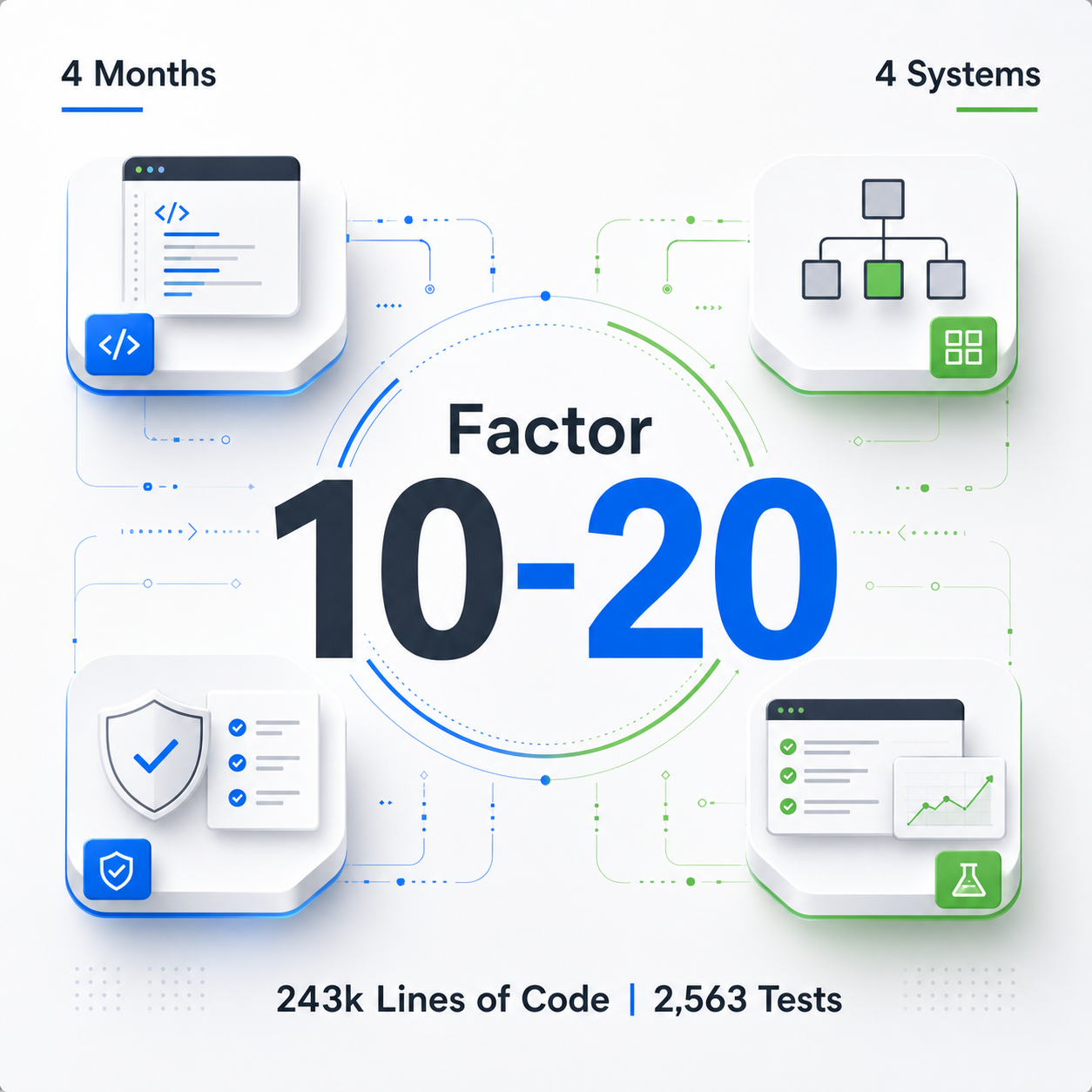
The BICon Logbook is, in essence, a press kit: a compact record of what was built at BICon between April and August 2026 — in what time, how, at what cost, and why it matters.
In those four months I built four software systems with the help of AI agents and without a development team: a multi-tenant B2B platform, a substantial investment application and two smaller systems. Counted, not estimated: 243,408 lines of code and at least 2,563 test cases.
A comparable build would classically have been budgeted at 0.6 to 1.3 million euros and nine to fifteen months of a team. The actual route was not free — roughly two months of one person plus AI tooling, around 57,000 euros in all — but the difference remains a factor of 10 to 20. The assumptions behind both figures are on the page; the arithmetic can be checked rather than believed.
The point of the logbook is not to present these systems. It documents a broader shift: the bottleneck in software development is moving away from programming itself and toward domain expertise, product judgement, governance, testing and accountability. The logbook records the limits as honestly as the figures — no generated line went unreviewed, and the page says plainly what the agents could not do.
The author matters here, and not for the usual reason. I am not a professional software developer. I have spent thirty years in business and IT consulting — commissioning, planning, budgeting and leading exactly these kinds of projects. The logbook is therefore not a technical showcase but evidence from practice: what happens when deep business knowledge can be translated directly into working software.
For journalists, the page provides the figures with their footnotes, disclosures, links to the running applications, press images and contact details. For banks, asset managers and advisory firms, it raises a sharper question: if one experienced domain expert can now build what previously required a team, what still needs to be bought, outsourced — or left on an IT backlog?