Pressematerial · BICon · Vaduz

Logbuch: Vier Monate, vier Systeme

Zwischen April und August 2026 hat ein Berater mit dreissig Jahren Berufserfahrung und ohne Entwicklerteam vier Systeme gebaut: eine mandantenfähige B2B-Plattform, eine umfangreiche Investmentanwendung und zwei kleinere Systeme. Was das über die Verschiebung des Engpasses in der Softwareentwicklung sagt, und welche Rechnungen dadurch nicht mehr aufgehen.

243 408Zeilen Code
2 563Testfälle, mindestens
4Systeme
1Person

Offenlegung: An der Plattform BICon Portfolio Steering (bicon.digital) bestehen kommerzielle Interessen — sie wird verkauft. Investment Decision Lab, Portfolio Prompt Builder und „Warum so investieren“ werden nicht kommerziell verwertet; sie sind frei zugänglich, dienen der Veranschaulichung und der Wissensvermittlung und stehen hier als Beleg für Bauweise und Umfang.

Kurzfassung

Zwischen April und August 2026 hat Volkmar Ritter, Business- und IT-Berater in Vaduz mit dreissig Jahren Berufserfahrung und ohne Hintergrund als Softwareentwickler, mithilfe von KI-Agenten und ohne Entwicklerteam vier Systeme gebaut: eine mandantenfähige B2B-Plattform, eine umfangreiche Investmentanwendung und zwei kleinere Anwendungen.

Ausgezählt wurden 192 643 Zeilen Anwendungscode, 50 765 Zeilen Testcode und mindestens 2 563 Testfälle. Klassisch wäre ein vergleichbares Vorhaben mit 0,6 bis 1,3 Millionen Euro sowie neun bis fünfzehn Monaten Teamarbeit veranschlagt worden. Die erste getestete und integrierte Fassung stand nach einer Woche, der heutige Funktionsumfang nach zwei Monaten.

Eines der vier Systeme, die Plattform BICon Portfolio Steering (bicon.digital), ist kommerziell ausgerichtet; die drei anderen sind nicht-kommerzielle Anwendungen.

Nächster öffentlicher Auftritt: 17. September 2026, Universität Liechtenstein, IT Crowd Club.

Die Zahlen

Vier Systeme, eine Person

System Anwendungscode Testcode Testfälle
Investment Decision Lab 93 708378 Dateien 27 17791 Dateien · 29 % 1 175
Portfolio Prompt Builder 4 517 2 83363 % 103
Warum so investierenReise mit dem Prompt Builder 3 7503 Dateien 5462 Dateien · 15 %
BICon Portfolio Steeringbicon.digital 90 668316 Dateien 20 209112 Dateien · 22 % 1 285
Zusammen 192 643 50 76526 % 2 563
Codemasse im VerhältnisAnwendungscodeTestcode
Investment Decision Lab120 885
Portfolio Prompt Builder7 350
Warum so investieren4 296
BICon Portfolio Steering110 877
Zusammen243 408

Balkenlänge im Verhältnis zu den 243 408 Zeilen insgesamt. Das Verhältnis von Test- zu Anwendungscode liegt über alle vier Systeme bei 26 Prozent — jener Posten, der in handgeschriebenen Projekten als Erstes gestrichen wird, wenn der Termin drückt.

Was das klassisch gekostet hätte — je grosse Plattform
Nearshore-Team mit Onshore-Führung
EUR 620 000 – 1 290 000
Dauer mit kleinem Team
9–15 Monate
Dauer für einen erfahrenen Full-Stack-Entwickler allein — reine Entwicklung, ohne Analyse und Projektleitung
2–4 Jahre
Zum Vergleich: tatsächliche Bauzeiten
Erste lauffähige Fassung eines Systems
Stunden
Je grosse Plattform: von der Idee zur ersten getesteten, integrierten Fassung im Mehrbenutzerbetrieb
max. 1 Woche
Je grosse Plattform: bis zum heutigen Funktionsumfang
rund 2 Monate
Tatsächliche Kosten: rund zwei Monate einer Person zu Onshore-Sätzen, samt Werkzeugkosten für die KI-Agenten
rund EUR 57 000
Kostenunterschied zur klassischen Variante
Faktor 10 bis 20
Die Rechnung im Verhältnis — je grosse Plattform
Klassische Schätzung — Team, 9–15 MonateEUR 620 000 – 1 290 000
Tatsächlich — eine Person, rund 2 Monaterund EUR 57 000
KostenunterschiedFaktor 10 bis 20

Balkenlängen im Verhältnis zum oberen Ende der klassischen Schätzung; der hellere Abschnitt zeigt die Spanne von 620 000 bis 1 290 000 Euro. Annahmen und Gegenrechnung in den Fussnoten unten.

Alle Zeilen- und Dateizahlen sind ausgezählt. Der mit KI-Agenten geschriebene Code ist darin vollständig enthalten — er ist der Gegenstand dieser Aufstellung. Nicht mitgezählt sind ausschliesslich Dateien, die ein Codegenerator automatisch aus einer Spezifikation erzeugt und bei jedem Build neu schreibt: bei BICon Portfolio Steering die aus der OpenAPI-Spezifikation abgeleiteten Client- und Schemadateien, Typdeklarationen und Vorlagenmanifeste. Gezählt ist also alles, was jemand — Mensch oder Agent — als Quelltext verantwortet hat. Für „Warum so investieren“ liegt keine Auszählung der einzelnen Testfälle vor; der Testcode selbst ist gezählt.

Die Kosten- und Dauerangaben oben sind keine Messung, sondern eine eigene Schätzung auf Grundlage von Angeboten, wie sie für vergleichbare Projekte üblich waren. Angenommen sind ein Nearshore-Team von vier Personen — Entwicklung, technische Analyse, Test und anteilig Architektur — über neun bis fünfzehn Monate zu 550 bis 700 Euro je Personentag, dazu onshore Projektleitung, Business-Analyse und fachlicher Auftraggeber mit zusammen einem Vollzeitäquivalent zu 1 100 bis 1 300 Euro. Nicht enthalten sind Betrieb, Lizenzen und Infrastruktur sowie die Mitwirkung der Fachbereiche für Workshops, Abnahmetests und Einführung.

Auch die tatsächliche Variante war nicht kostenlos: Sie hat rund zwei Monate der Arbeitszeit einer Person gebunden — zu einem Satz von 1 300 Euro je Personentag, dem oberen Ende der oben angesetzten Onshore-Sätze, ein Gegenwert von rund 55 000 Euro —, dazu Werkzeugkosten für die KI-Agenten von rund 1 000 Euro im Monat. Der Unterschied bleibt eine Grössenordnung; er wird hier nur vollständig gerechnet statt geschönt.

Was entstand

Vier Anwendungen, ein Verfahren

Investment Decision Lab

Anlegerprofilierung, regelbasierte Asset-Allokation, ETF-basierte Umsetzung mit vollständiger Durchschau, Stresstests, Gebührenanalyse, Monte-Carlo-Simulationen und historisches Backtesting.
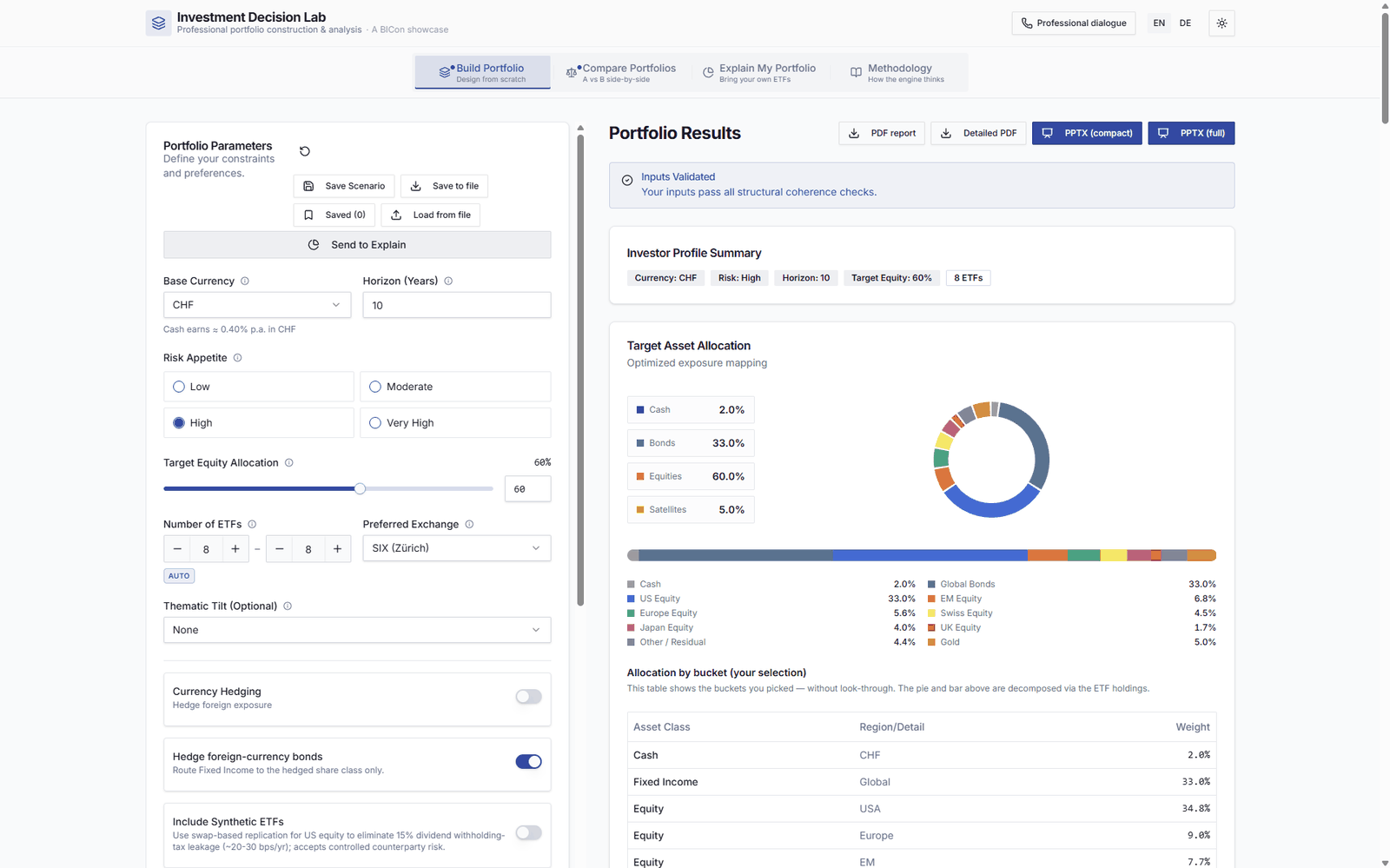
Investment Decision Lab — Portfolioaufbau mit Zielallokation
Portfolioaufbau mit Zielallokation

www.bicon.co — Anwendung starten · about.bicon.co — Überblick

Portfolio Prompt Builder

Macht aus einem Anlageprofil in Sekunden einen strukturierten, unmittelbar verwendbaren Prompt für die strategische Asset-Allokation — mit hinterlegter Logik für Home Bias, Währungsabsicherung und ETF-Auswahl. Zwei Stufen: Basic für schnelle Ergebnisse, Pro zur Feinsteuerung nach Anlagemandat.

Übersicht · Anwendung starten

Warum so investieren — eine Reise mit dem Portfolio Prompt Builder

Interaktives Lernformat, das Anlegerinnen und Anleger an strategische Asset-Allokation, ETFs und Markt-Timing heranführt. Einstieg: „Alle wollen den Markt schlagen. Fast niemand schafft es.“

Deutsch · English

BICon Portfolio Steering

Steuerung von KI-, Digital- und Transformationsportfolios: Priorisierung, Stage-Gate-Governance mit Risikosignalen, Berichte für Geschäftsleitung und Aufsichtsgremien. Dazu Inventar und Klassifizierung nach EU AI Act. Mandantenfähig, rollenbasierte Rechte, durchgängiger Änderungsnachweis, zweisprachige Dokumenterzeugung.
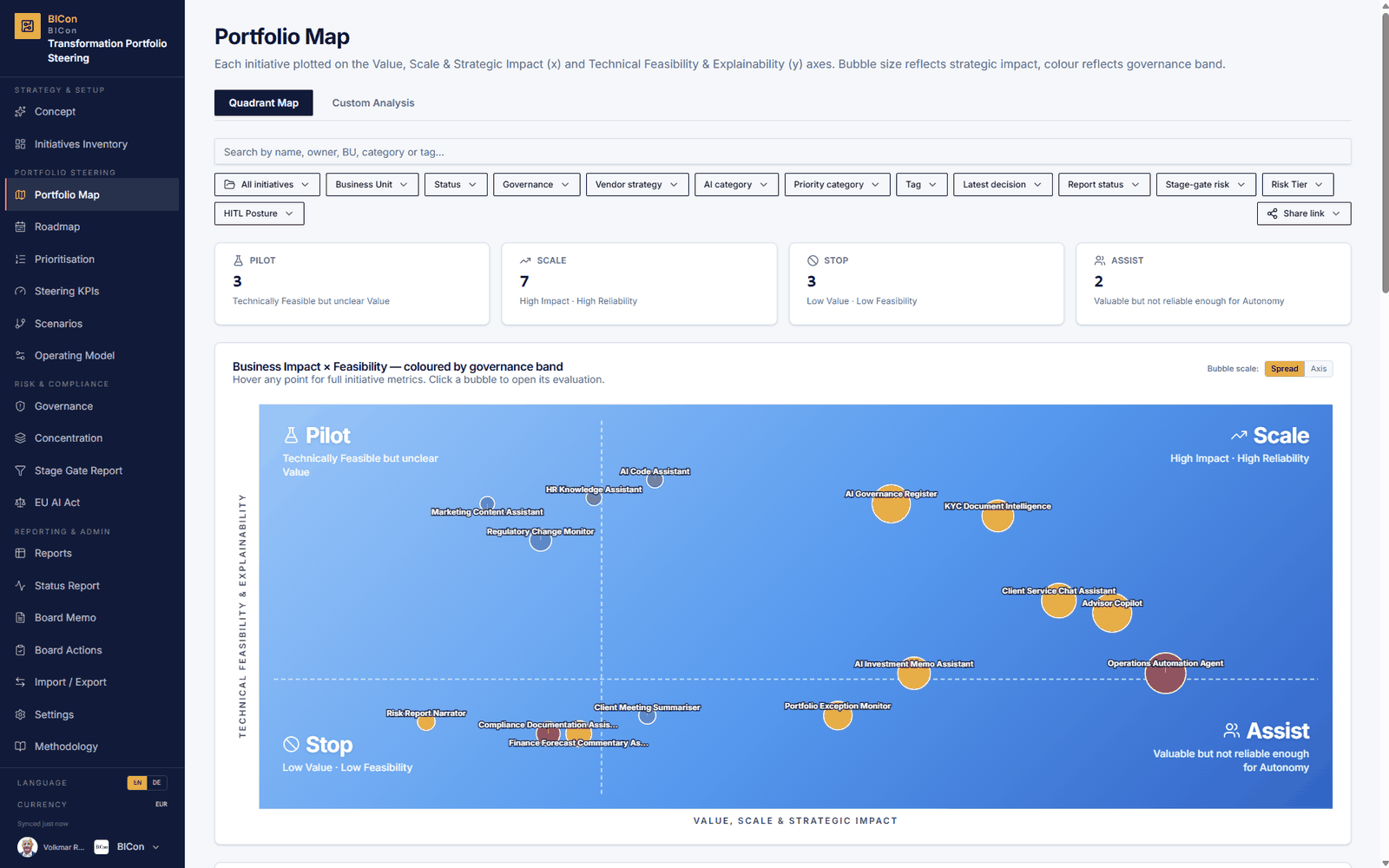
BICon Portfolio Steering — Portfolio Map mit Quadranten
Portfolio Map: Wirkung gegen Machbarkeit

www.bicon.digital — öffentliche Demo · about.bicon.digital — Überblick
Kommerzielles Angebot.

Beiträge zu den Anwendungen — Funktionsumfang und Releases: bicon.li — Showcase Tools

Die These

Der Engpass ist nicht mehr das Programmieren

Über künstliche Intelligenz im Finanzsektor wird meist im Zusammenhang mit Effizienz, Automatisierung und neuen Beratungsmodellen gesprochen. Die eigentliche Verschiebung liegt woanders: darin, wie digitale Systeme überhaupt entstehen.

Die Fähigkeit, Wissen strukturiert zu formulieren, wird wichtiger als klassische Programmierkenntnisse. Volkmar Ritter gegenüber finews.ch, 12. Juni 2026

Fachlogik wird nicht mehr beschrieben und anschliessend von Entwicklern umgesetzt, sondern direkt in ausführbare Systeme übersetzt. Damit verschwimmt die Grenze zwischen Konzept, Modell und fertiger Anwendung — ein Investmentprozess wird nicht mehr dokumentiert, sondern unmittelbar in Betrieb genommen.

Für Banken, Vermögensverwalter und Beratungshäuser verschiebt sich der Engpass damit von der technischen Umsetzung hin zu Governance, Qualitätssicherung und Distribution.

Die Folge

Vier Rechnungen, die nicht mehr aufgehen

Ein einzelner Fall beweist keine Branche — vier Systeme von einer Person sind eine Beobachtung, kein Datensatz. Aber die Beobachtung genügt, um zu zeigen, dass die folgenden Rechnungen nicht mehr selbstverständlich aufgehen.

Wenn ein Vorhaben, für das nach üblichen Sätzen 0,6 bis 1,3 Millionen Euro und neun bis fünfzehn Monate eines Teams anzusetzen waren, von einer Person in Wochen gebaut wird, ändert das nicht nur ein Budget. Es zieht mehrere Annahmen mit, auf denen die Softwarewirtschaft seit Jahrzehnten ruht.

Nearshore und Offshore verlieren ihren Zweck

Ihr Wert war Kostenarbitrage auf die Umsetzung — dieselbe Arbeit, günstiger erbracht. Die Umsetzung ist nicht mehr der teure Teil. Damit fällt nicht der Preisvorteil weg, sondern der Gegenstand, auf den er sich bezog.

Der IT-Backlog verliert seinen grössten Posten

Seit dreissig Jahren eine feste Einrichtung jeder Organisation: die Liste der Anforderungen, für die keine Kapazität da ist. Zu einem grossen Teil war sie nie ein Priorisierungsinstrument, sondern die Verwaltung eines Mangels. Dieser Mangel verschwindet. Was bleibt, sind die Gründe, die nie an der Kapazität hingen — Abhängigkeiten, Datenlage, Zuständigkeiten. Der Backlog wird also nicht leer; er verliert seinen grössten Posten und damit seine gewohnte Rechtfertigung.

Make or Buy dreht sich um

Der Kauf von Standardsoftware hatte zwei Begründungen: Bauen ist teuer, und jemand anders trägt danach Wartung, Nachführung und Haftung. Die erste ist weggefallen, die zweite nicht. Wer ein Werkzeug lizenzierte, das zu achtzig Prozent passte, weil die fehlenden zwanzig Prozent als Eigenentwicklung nicht zu rechtfertigen waren, baut sie jetzt selbst. Und wo der Bedarf so speziell ist, dass kein Anbieter davon leben kann, fällt auch der zweite Grund weg — dort stellt sich die Kauffrage nicht mehr.

Knapp wird etwas anderes

Governance, Wartbarkeit, Vertrauen — und die Fähigkeit zu entscheiden, was überhaupt gebaut werden soll. Beim EU AI Act kehrt sich die Rechnung sogar um: Wer ein KI-System selbst baut, ist nicht mehr Betreiber, sondern Anbieter, und die Pflichten hängen am Anbieter. Selbst bauen macht die Regulierung nicht billiger, sondern teurer.

Seit Anfang 2026 läuft darüber eine Debatte unter dem Schlagwort „SaaSpocalypse“; die Bewertungen börsennotierter Softwareanbieter sind nach Branchenzahlen von rund dem Achtzehnfachen des Jahresumsatzes im Jahr 2021 auf etwa das Fünffache Ende 2025 gefallen. Geführt wird sie von Analysten, Investoren und Beratern — von Leuten, die selbst gebaut haben, hört man wenig.

Die Grenzen

Was KI nicht ersetzt hat

nichtden Bedarf an Software-Engineering
nichtdie Produktarbeit
nichtdas Fachwissen

Gesunken ist der Preis dafür, aus einer Idee laufende Software zu machen. Die Zeit, die nicht mehr ins Schreiben von Code floss, ging in den Entwurf des Produkts, in das Lesen und Auslegen des EU AI Act, in die Definition von Governance- und Bewertungsmodellen, in das Prüfen, Verwerfen und Nachschärfen dessen, was die Agenten erzeugt hatten — und in tausende Architektur- und Produktentscheidungen.

They never got tired. They never complained. But they also never decided what should be built. Aus dem eigenen Werkstattbericht

Die automatisierten Tests sind in dieser Rechnung keine Nebengrösse, sondern die Kontrolle. Über alle Systeme stehen 50 765 Zeilen Testcode und mindestens 2 563 Testfälle gegen 192 643 Zeilen Anwendungscode — ein Verhältnis von 26 Prozent, im Investment Decision Lab 29, im Prompt Builder 63. Bemerkenswert ist nicht die Höhe, sondern dass dieser Posten unter Termindruck nicht gestrichen wurde — in handgeschriebenen Projekten ist er der erste, der fällt. Genau dieser Zielkonflikt entfällt. Die Tests sind der Grund, warum sich das Ergebnis prüfen lässt, statt ihm glauben zu müssen — und aus demselben Gedanken heraus erhalten Kunden Lesezugriff auf ein gepflegtes Repository ab dem ersten Tag: Wer nicht vertrauen will, soll nachsehen können.

Ohne Prüfung hätte davon nichts Bestand. Kein erzeugter Code ist ungeprüft geblieben — jede Zeile ist unmittelbar nach der Erstellung in ein Review gegangen, durchgeführt von KI-Agenten, dazu kamen gesonderte Reviews für Sicherheit und Due Diligence. Die Zahl der Durchgänge liegt in der Grössenordnung der Commits: über tausend je grosser Plattform. Diese Reviews haben Schwachstellen gezeigt. Behoben wurden sie alle; aber sie waren da, und ohne den Prüfschritt wären sie geblieben. Das ist der nüchterne Befund dieser vier Monate: Agenten liefern schnell und in Menge; ob das Ergebnis trägt, entscheidet sich im Review. Wer diesen Schritt weglässt, bekommt nicht dieselbe Software billiger, sondern eine andere.

Zur Kontrolle gehört ein zweiter Schritt. Beide grossen Plattformen hat nach der Fertigstellung ein KI-Agent selbständig durchgearbeitet und rezensiert — ohne inhaltliche Vorgabe von mir, unredigiert veröffentlicht, samt der kritischen Stellen. Eine unabhängige Prüfung durch Dritte ist das nicht, sondern ein offengelegtes Verfahren: Die Rezensionen stehen auf der Website des Anbieters, und es gibt sie, weil ich sie angestossen habe. Mehrere der dort benannten Lücken sind inzwischen geschlossen, ohne dass am Text etwas geändert wurde. Gebaut hat ein Agent, geprüft ein zweiter — entschieden habe ich.

Der Arbeitsplatz

Ein Teil davon ist auf einem Segelboot entstanden
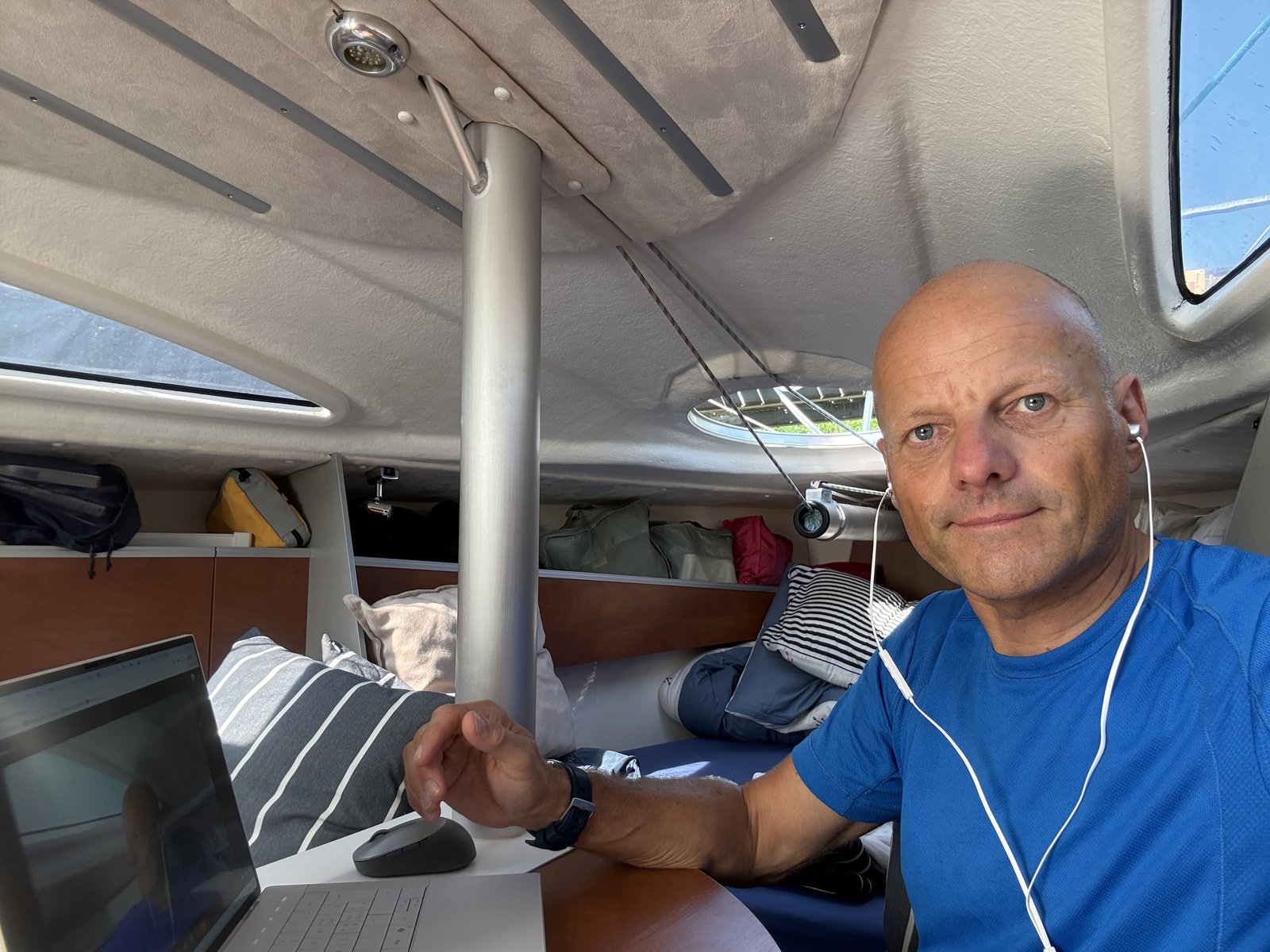
Volkmar Ritter arbeitet mit Laptop in der Kajüte eines Segelboots
Harbor Office — Bodensee, Sommer 2026. Bild: BICon

Gearbeitet wurde an diesen Systemen zu einem erheblichen Teil nicht am Schreibtisch, sondern auf einem Segelboot am Bodensee. Die „Harbor Office“-Notizen auf LinkedIn halten das fortlaufend fest.

Das ist keine Randbemerkung, sondern gehört zur Sache. Ein Vorhaben dieser Grösse bindet klassisch ein Team, eine Planung und einen Betrieb, der Termine hält. Wer Fachlogik strukturiert, Ergebnisse prüft und entscheidet, braucht Ruhe, Konzentration und eine Verbindung, die ein paar Stunden hält. Der Ortswechsel macht sichtbar, was der Engpass heute ist — und was er nicht mehr ist.

Wer die Behauptung dieser Seite bestreiten will, findet hier den besten Ansatzpunkt. Entstanden ist das nicht nebenbei, sondern ortsunabhängig, in konzentrierten Arbeitsblöcken. Klassisch wäre ein Vorhaben dieser Grösse an einen Ort, ein Team und einen Kalender gebunden gewesen. Genau deshalb steht es hier.

Chronik
Presse

Bereits erschienen

finews.ch · 12. Juni 2026 · Dominik Buholzer, Chefredaktor

Die nächste Disruption im Banking kommt aus der Softwareentwicklung

Über die selbst entwickelten Anwendungen und ihre Folgen für Banken, Vermögensverwalter und Berater. finews.ch hat den kommerziellen Bezug offen ausgewiesen.

Nächster öffentlicher Auftritt: 17. September 2026 an der Universität Liechtenstein, IT Crowd Club — „KI-Agenten für Business und Entwicklung“.

Für Redaktionen

Auf Anfrage, in der Regel am selben Tag: eine Vorführung der Systeme — persönlich in Vaduz oder per Video —, weitere Screenshots und ein Gespräch. Lesezugriff auf das Repository nach Unterzeichnung einer Vertraulichkeitsvereinbarung. Kontakt steht unten.

Harbor Office, Bodensee
Herunterladen
Porträt Volkmar Ritter
Herunterladen
BICon Portfolio Steering — Portfolio Map
Herunterladen
Investment Decision Lab
Herunterladen

Bilder honorarfrei bei Nennung „Bild: BICon“. Originalauflösung auf Anfrage.

Zur Person

Volkmar Ritter

Porträt Volkmar Ritter
Volkmar Ritter, Vaduz. Bild: BICon

Dreissig Jahre Business- und IT-Beratung, davon fünfundzwanzig mit der eigenen Firma BICon in Vaduz — Beratung für die Finanzbranche an der Schnittstelle von Geschäft und Technologie. Verwaltungsrat und Universitätsdozent. Kein Entwickler von Beruf.

Das ist der Punkt, an dem sich diese Geschichte von den üblichen unterscheidet: Sie kommt nicht von jemandem, der am Anfang steht, sondern von jemandem, der drei Jahrzehnte lang genau solche Projekte beauftragt, geplant, budgetiert, in der Umsetzung geführt und verantwortet hat.

Lebenslauf und Mandate

Kontakt
Telefon+423 791 19 21
Beratungbicon.li
Plattformbicon.digital
AnschriftSpaniagasse 5A, FL-9490 Vaduz
Weitere Bilder, Screenshots und Angaben auf Anfrage. Kommerzielle Interessen bestehen ausschliesslich an BICon Portfolio Steering (bicon.digital); die drei übrigen Anwendungen sind nicht kommerzieller Natur und dienen ausschliesslich der Veranschaulichung und der Wissensvermittlung.

Press material · BICon · Vaduz

Logbook: Four Months, Four Systems

Between April and August 2026 a consultant with thirty years in the profession and no development team built four systems: a multi-tenant B2B platform, a substantial investment application and two smaller ones. What that says about where the bottleneck in software development has moved, and which calculations no longer hold.

243,408lines of code
2,563test cases, at least
4systems
1person

Disclosure: commercial interests exist in the BICon Portfolio Steering platform (bicon.digital) — it is sold. Investment Decision Lab, Portfolio Prompt Builder and “Why invest this way” are not commercialised; they are freely accessible, serve demonstration and educational purposes, and appear here as evidence of how and at what scale the work was done.

In brief

Between April and August 2026, Volkmar Ritter, a business and IT consultant in Vaduz with thirty years of professional experience and no background as a software developer, built four systems with AI agents and without a development team: a multi-tenant B2B platform, a substantial investment application and two smaller applications.

The count: 192,643 lines of application code, 50,765 lines of test code and at least 2,563 test cases. Conventionally, comparable work would have been estimated at EUR 0.6 to 1.3 million and nine to fifteen months of team effort. The first tested and integrated version was completed within one week; the current scope was reached after two months.

One of the four systems, the BICon Portfolio Steering platform (bicon.digital), is commercial in nature; the other three are not.

Next public appearance: 17 September 2026, University of Liechtenstein, IT Crowd Club.

The figures

Four systems, one person

System Application code Test code Test cases
Investment Decision Lab 93,708378 files 27,17791 files · 29 % 1,175
Portfolio Prompt Builder 4,517 2,83363 % 103
Why invest this waya journey with the Prompt Builder 3,7503 files 5462 files · 15 %
BICon Portfolio Steeringbicon.digital 90,668316 files 20,209112 files · 22 % 1,285
Total 192,643 50,76526 % 2,563
Relative code massApplication codeTest code
Investment Decision Lab120,885
Portfolio Prompt Builder7,350
Why invest this way4,296
BICon Portfolio Steering110,877
Total243,408

Bar length is proportional to the 243,408 lines in total. The ratio of test to application code is 26 per cent across all four systems — the line item that is cut first in hand-written projects once the schedule tightens.

What this would classically have cost — per large platform
Nearshore team with onshore leadership
EUR 620,000–1,290,000
Elapsed time with a small team
9–15 months
Elapsed time for one experienced full-stack developer alone — development only, without analysis or project management
2–4 years
For comparison: actual build times
First running version of a system
hours
Per large platform: from idea to the first tested, integrated, multi-user release
1 week at most
Per large platform: to the current functional scope
about 2 months
Actual cost: roughly two months of one person at onshore rates, including AI tooling
around EUR 57,000
Cost difference versus the classical route
a factor of 10 to 20
The arithmetic in proportion — per large platform
Classical estimate — a team, 9–15 monthsEUR 620,000–1,290,000
Actual — one person, about 2 monthsaround EUR 57,000
Cost differencea factor of 10 to 20

Bar lengths in proportion to the upper end of the classical estimate; the lighter section shows the range from 620,000 to 1,290,000 euros. Assumptions and counter-calculation in the footnotes below.

All line and file counts are measured. Code written with AI agents is fully included — it is the very subject of this table. What is excluded are only files a code generator produces automatically from a specification and rewrites on every build: for BICon Portfolio Steering the client and schema files derived from the OpenAPI specification, type declarations and template manifests. In other words, everything counted was authored as source by someone — human or agent. For “Why invest this way” the test code is counted, but the individual test cases have not been tallied.

The cost and duration figures above are not measurements but an own estimate based on quotations typical for comparable projects. It assumes a nearshore team of four — development, technical analysis, test and a share of architecture — over nine to fifteen months at 550 to 700 euros per person-day, plus project management, business analysis and a business owner onshore at one full-time equivalent combined, at 1,100 to 1,300 euros. Operations, licences and infrastructure are not included, nor the business units’ involvement in workshops, acceptance testing and rollout.

The actual route was not free either: it tied up roughly two months of one person’s time — worth around 55,000 euros at 1,300 euros per person-day, the top of the onshore rates assumed above — plus AI tooling at around 1,000 euros a month. The difference remains an order of magnitude; it is simply calculated in full rather than flattered.

What was built

Four applications, one method

Investment Decision Lab

Investor profiling, rule-based asset allocation, ETF-based implementation with full look-through, stress tests, fee analysis, Monte Carlo simulations and historical backtesting.

Investment Decision Lab — portfolio construction with target allocation
Portfolio construction with target allocation

www.bicon.co — launch the application · about.bicon.co — overview

Portfolio Prompt Builder

Turns an investor profile into a structured, immediately usable prompt for strategic asset allocation in seconds — with built-in logic for home bias, currency hedging and ETF selection. Two levels: Basic for quick results, Pro for fine-tuning to an investment mandate.

Overview · Launch the builder

Why invest this way — a journey with the Portfolio Prompt Builder

An interactive format that introduces investors to strategic asset allocation, ETFs and market timing. It opens with: “Everyone wants to beat the market. Almost nobody does.”

English · Deutsch

BICon Portfolio Steering

Steering of AI, digital and transformation portfolios: prioritisation, stage-gate governance with risk signals, reporting for executive and supervisory bodies. Plus AI system inventory and classification under the EU AI Act. Multi-tenant, role-based permissions, end-to-end change audit trail, bilingual document generation.

BICon Portfolio Steering — portfolio map with quadrants
Portfolio map: impact against feasibility

www.bicon.digital — public demo · about.bicon.digital — overview
Commercial offering.

Posts about the applications — scope and releases: bicon.li — Showcase Tools

The argument

Writing code is no longer the bottleneck

Artificial intelligence in financial services is usually discussed in terms of efficiency, automation and new advisory models. The real shift lies elsewhere: in how digital systems come into existence at all.

The ability to formulate knowledge in a structured way is becoming more important than classical programming skills. Volkmar Ritter to finews.ch, 12 June 2026

Domain logic is no longer described and then implemented by developers; it is translated directly into executable systems. The line between concept, model and finished application blurs — an investment process is no longer documented, it is put into operation.

For banks, asset managers and consultancies the bottleneck therefore moves away from technical implementation and towards governance, quality assurance and distribution.

The consequence

Four calculations that no longer hold

A single case proves no industry — four systems by one person are an observation, not a dataset. But the observation is enough to show that the following calculations no longer hold as a matter of course.

When a project that would conventionally have been costed at 0.6 to 1.3 million euros and nine to fifteen months of a team is built by one person in weeks, more changes than a budget. It pulls several assumptions with it — assumptions the software industry has rested on for decades.

Nearshore and offshore lose their purpose

Their value was cost arbitrage on implementation: the same work, delivered cheaper. Implementation is no longer the expensive part. What disappears is not the price advantage but the thing it applied to.

The IT backlog loses its largest item

For thirty years a fixture of every organisation: the list of requirements there is no capacity for. In large part it was never a prioritisation instrument but the administration of a shortage. That shortage goes. What remains are the reasons that never had anything to do with capacity — dependencies, the state of the data, who owns what. The backlog does not empty; it loses its largest item, and with it its habitual justification.

Make-or-buy inverts

Buying standard software rested on two arguments: building is expensive, and someone else then carries maintenance, regulatory upkeep and liability. The first has gone; the second has not. Anyone who licensed a tool that fits eighty per cent, because the missing twenty could not be justified as in-house development, now builds that twenty. And where the requirement is so specific that no vendor can make a living from it, the second argument falls away too — there the buy question no longer arises.

Something else becomes scarce

Governance, maintainability, trust — and the judgement to decide what should be built at all. Under the EU AI Act the arithmetic even inverts: build an AI system yourself and you are no longer the deployer but the provider, and the obligations attach to the provider. Building it in-house does not make the regulation cheaper. It makes it dearer.

Since early 2026 this has been debated under the label “SaaSpocalypse”; valuations of listed software companies fell from roughly eighteen times annual revenue in 2021 to around five by late 2025, on industry figures. The debate is conducted by analysts, investors and consultants — voices from people who have actually built something are scarce.

The limits

What AI did not replace

notthe need for software engineering
notproduct management
notdomain expertise

What fell was the cost of turning an idea into working software. The time no longer spent writing code went into designing the product, reading and interpreting the EU AI Act, defining governance and scoring models, testing, refining and challenging what the agents produced — and making thousands of architectural and product decisions.

They never got tired. They never complained. But they also never decided what should be built. From the author’s own workshop notes

The automated tests are not a footnote in this account but the control. Across all systems, 50,765 lines of test code and at least 2,563 test cases stand against 192,643 lines of application code — a ratio of 26 per cent overall, 29 in the Investment Decision Lab, 63 in the Prompt Builder. What is notable is not the level but that this budget was never cut under time pressure — in hand-written projects it is the first to go. Precisely that trade-off disappears. The tests are the reason the result can be checked rather than believed — and from the same thinking, customers receive read access to a maintained repository from day one: anyone who would rather not trust should be able to look.

None of it would hold without review. No generated code was left unreviewed — every line went into review immediately after it was written, carried out by AI agents, and on top of that came dedicated security and due-diligence reviews. The number of passes is of the same order as the commits: more than a thousand for each of the two large platforms. Those reviews turned up weaknesses. All of them were fixed; but they were there, and without the review step they would have stayed. That is the sober finding of these four months: agents deliver fast and in volume; whether the result holds is decided in review. Skip that step and you do not get the same software more cheaply, you get different software.

There is a second step to that control. Once each of the two large platforms was finished, an AI agent worked through it on its own and wrote a review — no brief from me, published unedited, critical passages included. That is not an independent third-party assessment but a method laid open: the reviews sit on the vendor’s own website, and they exist because I started them. Several of the gaps they name have since been closed, with nothing altered in the text. An agent built, a second agent reviewed — and I decided.

Where the work happened

Part of this was built on a sailing boat

Volkmar Ritter working on a laptop in the cabin of a sailing boat
Harbor Office — Lake Constance, summer 2026. Picture: BICon

A substantial share of the work on these systems was done not at a desk but aboard a sailing boat on Lake Constance. The “Harbor Office” notes on LinkedIn record it as it goes.

This is not an aside; it belongs to the argument. Conventionally, a project of this size ties up a team, a plan and an operation that keeps to dates. Structuring domain logic, reviewing results and deciding takes quiet, concentration and a connection that holds for a few hours. The change of place makes visible what the bottleneck is today — and what it no longer is.

Anyone wanting to contest the claim made on this page will find their best opening here. None of it was done on the side: it was done independently of place, in concentrated blocks of work. Conventionally a project of this size would have been tied to one location, a team and a calendar. That is precisely why it is stated.

Chronicle
Press

Already published

finews.ch · 12 June 2026 · Dominik Buholzer, Editor-in-Chief

Die nächste Disruption im Banking kommt aus der Softwareentwicklung

“Banking’s next disruption comes from software development”. On the self-built applications and their implications for banks, asset managers and advisers. finews.ch disclosed the commercial interest openly.

Next public appearance: 17 September 2026 at the University of Liechtenstein, IT Crowd Club — “AI agents for business and development”.

For editorial desks

On request, usually the same day: a live demonstration of the systems — in person in Vaduz or by video — further screenshots and an interview. Read access to the repository once a non-disclosure agreement has been signed. Contact details below.

Harbor Office, Lake Constance
Download
Portrait of Volkmar Ritter
Download
BICon Portfolio Steering — portfolio map
Download
Investment Decision Lab
Download

Pictures free of charge with the credit “Picture: BICon”. Original resolution on request.

The person

Volkmar Ritter

Portrait of Volkmar Ritter
Volkmar Ritter, Vaduz. Picture: BICon

Thirty years in business and IT consulting, twenty-five of them with his own firm BICon in Vaduz — advising the financial industry at the intersection of business and technology. Board member and university lecturer. Not a developer by trade.

That is where this story differs from the usual one. It does not come from someone at the start of a career, but from someone who spent three decades commissioning such projects, planning them, budgeting them, steering their delivery and answering for them.

Full CV and mandates

Contact
Phone+423 791 19 21
Consultingbicon.li/en
AddressSpaniagasse 5A, FL-9490 Vaduz